
Benchmark Case for AI Vision Acceleration from Concept to Mass Production Project
Overview
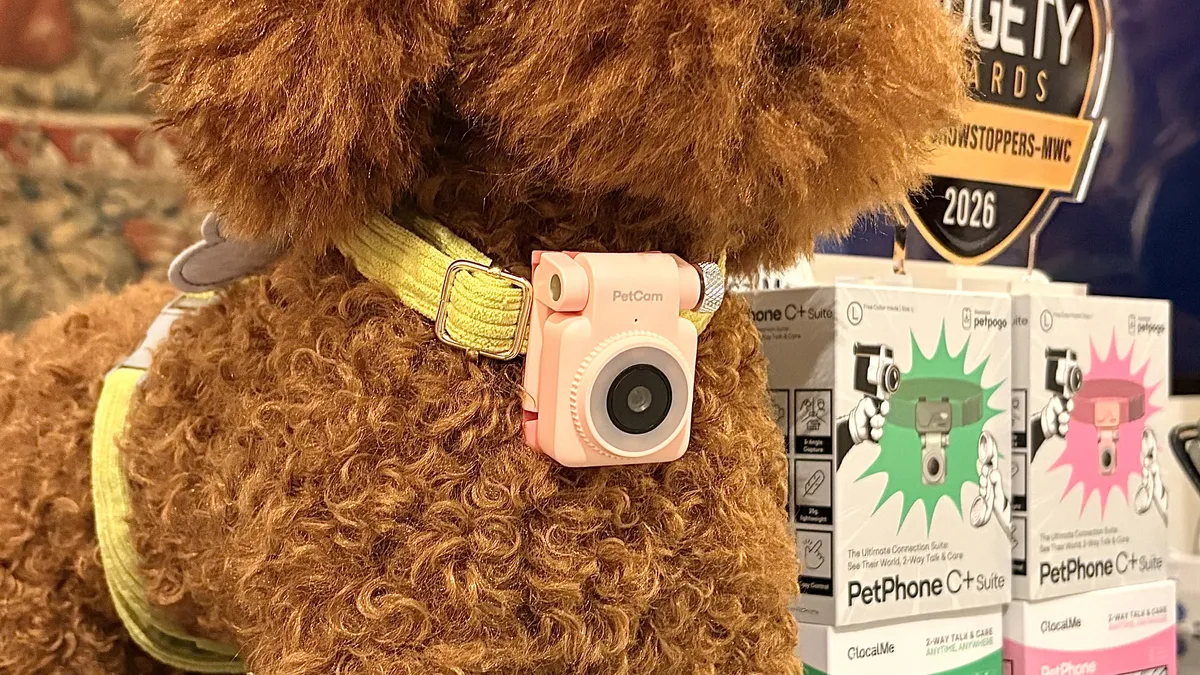
At CES 2026, Kickers.ai, a leading AIoT vision system provider, officially launched its new business segment POC Studio (Vision Product Definition & Feasibility Validation Center). In partnership with UCloudLink, Kickers.ai successfully launched PetCam, a first-person pet smart camera, realizing one-stop validation and commercialization from Prompt (concept) to Product (mass production), providing a replicable engineering solution for the AI vision industry.
Industry Pain Points
1. Abundant visual innovation concepts, but difficult engineering implementation, long validation cycles and high mass production risks;
2. Wearable devices face technical bottlenecks such as limited size, high power consumption, poor environmental adaptability and unstable imaging;
3. Enterprises lack full-stack technical support from concept validation to large-scale mass production.

Solution: Core Capabilities of POC Studio
Relying on Kickers.ai's full-stack expertise in optical design, camera modules, edge AI algorithms, system integration and intelligent manufacturing, POC Studio builds a closed loop of "Concept Validation → POC Demo → Engineering → Mass Production", helping enterprises quickly verify product feasibility and greatly shorten time-to-market.
Benchmark Practice: PetCam, Pet Smart Camera
As a system-level partner, Kickers.ai deeply participated in the whole development process of PetCam and overcame multiple technical and experience challenges:
1. Imaging Technology: 1080P FHD + 2.7μm large pixel + wide-angle design, clear imaging in low-light environments, restoring the real perspective of pets;
2. Stability & Reliability: Wide-temperature operation from -10℃ to 60℃, low power consumption and long battery life, adapting to complex indoor and outdoor scenarios;
3. Product Philosophy: Lightweight wearable design, focusing on companion recording instead of privacy monitoring, balancing technology and emotion;
4. Commercialization Efficiency: Rapid validation through POC Studio, seamless connection to mass production, creating a benchmark for AIoT pet vision.
From an Engineer’s Perspective: Technical Decision-Making & Project Stories
I. Project Background: Why We Took On This "Extreme Challenge"
As a vision engineering team, we are often asked: “What’s so hard about building a pet camera?”
Yet the PetCam project we defied conventions from the very start. We aimed to develop an ultra-light wearable device under 25 grams, light enough for cats and dogs to wear comfortably for extended periods. It had to deliver consistent imaging performance across harsh conditions: dim indoor light, intense outdoor sunlight, subzero temperatures and scorching summer heat. Traditional bulky heat dissipation solutions for surveillance cameras were not an option, nor could we compromise on image quality or battery life.
For us, this was far more than just building a camera. It was an intricate engineering balancing act to maximize performance across four key dimensions: weight, power consumption, image quality and operational reliability.
II. Technical Challenges & Engineering Decision Stories

1. Why We Insisted on a 2.7μm Large-Pixel Image Sensor
The team held intense discussions in the early project phase over two technical routes:
Option A: Adopt high-resolution sensors with smaller pixel sizes (1.75μm / 2.0μm). This solution featured lower costs and a more compact form factor, but suffered from insufficient light intake, resulting in heavy image noise indoors and at night.
Option B: Use a 2.7μm large-pixel sensor. It boosted physical light intake by around 50% and greatly improved the signal-to-noise ratio in low-light environments. However, its larger package size created major hurdles for structural design and heat dissipation.
We ultimately chose Option B and rolled out full customized optimizations for it.
Pet activities mostly take place indoors or at dusk, so poor light reception would be a critical flaw. To address the size issue, we customized optical lenses and adopted specially shaped PCB cutting to minimize the sensor’s footprint. We also optimized ISP algorithms to deliver crisp, clear 1080p footage with authentic color reproduction even in low-light scenarios.
This was a classic case of technical trade-offs: we deliberately took on greater challenges in optical and structural design to deliver a superior user experience.
2. Wide-Temperature Operation: From Theoretical Feasibility to Proven Stability — A Tough Battle for Heat Dissipation
PetCam was required to operate stably across a wide temperature range of -10°C to 60°C, an extreme target for a device weighing less than 25 grams.
Conventional outdoor cameras rely on metal enclosures for heat dissipation, which was impossible to implement here. Early prototypes suffered from surging thermal noise and performance throttling once the ambient temperature exceeded 45°C.
We adopted a dual-protection solution combining passive heat dissipation and dynamic power consumption control:
Hardware: Large-area copper foil on PCBs paired with thermal silicone pads evenly dispersed heat generated by the sensor and power management chips across the enclosure, eliminating localized hotspots.
Software: We developed a dynamic power regulation algorithm that automatically adjusted frame rates and ISP workload based on real-time temperature and operating scenarios. Under high temperatures, image stability was prioritized over maximum performance.
After three rounds of iterations, the final product passed cyclic high-low temperature chamber tests and maintained normal operation in extreme environments.
3. Lightweight Design & Wearing Comfort: Built for Our Furry Friends
Most wearable devices are designed around human usage habits, with little consideration for pets’ comfort.
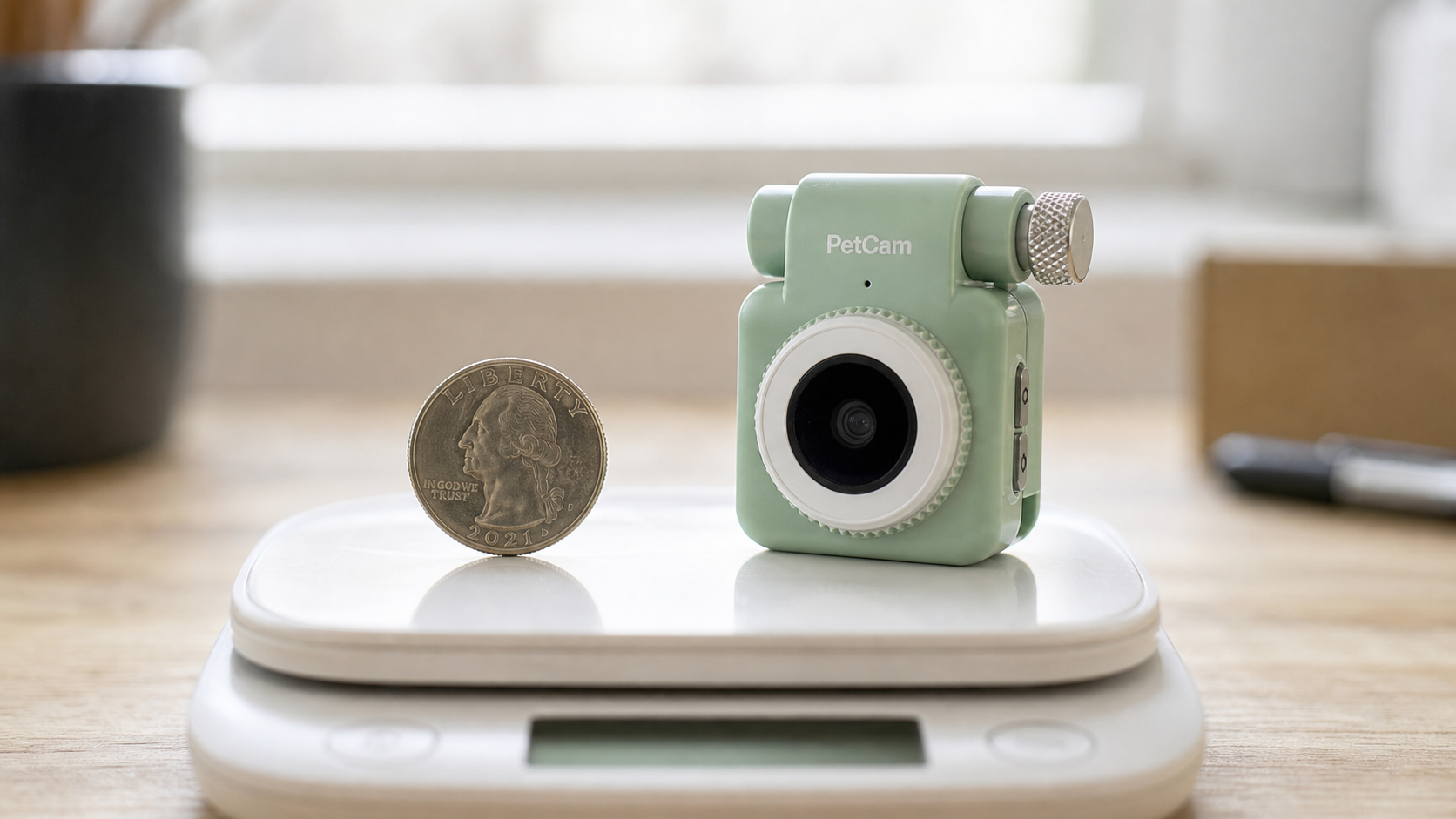
We brought the total device weight down to under 25 grams — roughly the weight of a single coin. The outer shell features fully rounded edges and anti-slip treatment to prevent irritation or injury to pets’ skin.
We abandoned surveillance-style design concepts entirely. Centered on the idea of *companion recording*, the device lets owners see the world through their pets’ eyes, rather than acting as an intrusive monitoring tool.
III. How POC Studio Accelerated Project Delivery
From conceptual design to mass-production prototypes, the project was completed in just one-third of the typical development cycle, largely thanks to Kickers.ai team:
Rapid Verification: We built integrated prototypes combining optics, algorithms and mechanical structures, verifying the feasibility of the 2.7μm sensor solution within just two weeks.
Efficient Trial-and-Error: Leveraging standardized testing equipment, we ran parallel tests on three heat dissipation schemes and two power consumption solutions, quickly phasing out unviable technical paths.
Seamless Transition to Mass Production: Designs finalized at the POC stage were fully aligned with mass production processes, avoiding costly large-scale mold revisions in later phases.
IV. Project Outcomes & Industry Value
Delivered the world’s first 25g-level wide-temperature pet first-person view camera.
Validated the technical viability of vision systems combining large-pixel sensors, low power consumption and wide-temperature stability for ultra-lightweight wearable devices.
Established a replicable engineering implementation roadmap for wearable AIoT products.

Industry Value
POC Studio provides low-risk, high-efficiency and mass-producible visual innovation paths for wearable, smart home, industrial vision, automotive and other fields, promoting AI vision technology from labs to real-life scenarios.